
Precise, Contactless, Smarter: LiDAR 3D Measurement Powers Fully Automated Transformer Lifting
Solution: Shiju Network-LiDAR LiDAR 3D intelligent guidance system
Customer background and pain points
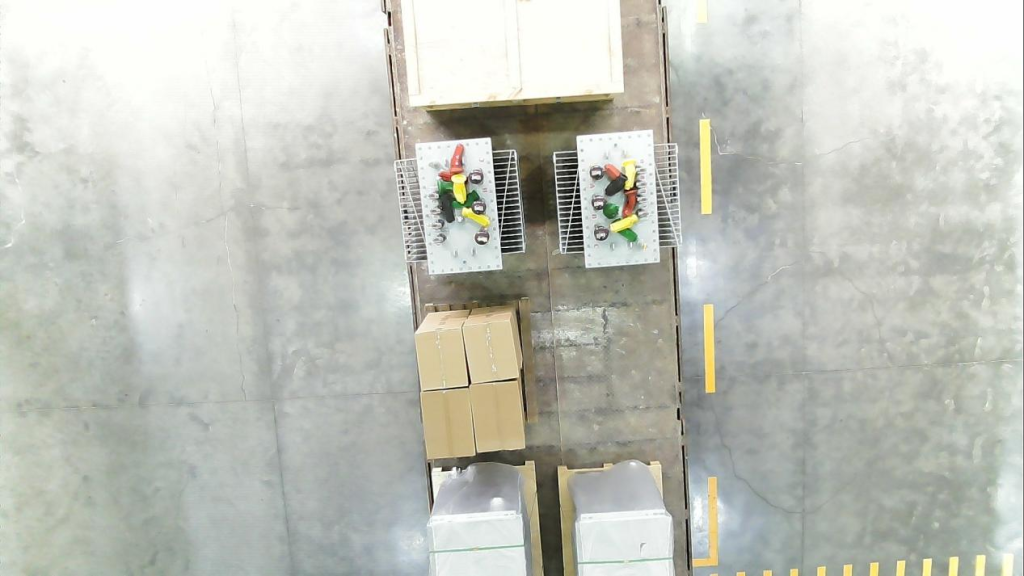
The customer is a large transformer manufacturer in China that routinely loads and unloads transformers. For a long time this process relied entirely on operators manually controlling overhead cranes, which required dedicated staff on site and created a series of operational challenges:
- Heavy labor dependency: every load/unload requires skilled operators on site, driving labor cost and making parallel tasks difficult;
- High cargo-safety risk: transformers are heavy precision equipment with fragile housings; blind spots or judgment errors during manual operation can cause collisions, damage, financial loss, and delivery delays;
- Efficiency bottleneck: manual positioning and adjustment take a long time and slow logistics turnover;
- Low process standardization: quality stability depends on individual operator experience.
Solution: Shiju Network-LiDAR LiDAR 3D intelligent guidance system
To address these pain points, Shiju Network built a tailored real-time LiDAR 3D measurement and automatic control system that automates the full crane loading and unloading workflow.
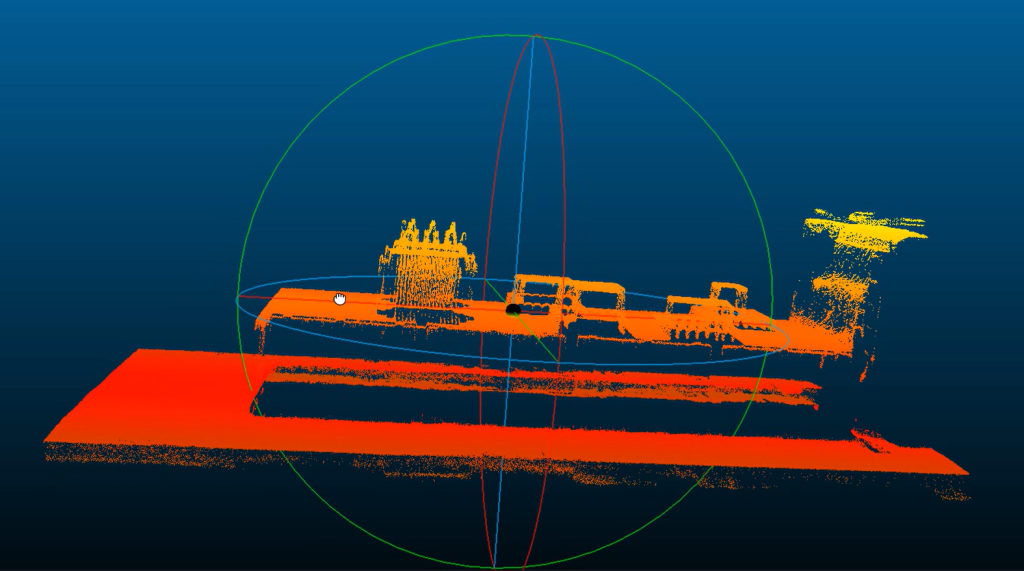
- System deployment: high-precision LiDAR units are installed above loading and unloading zones to scan and obtain 3D point clouds of the work area in real time, then send processed data to the PLC and host system over industrial Ethernet.
How it works and implementation steps
Step 1: Intelligent truck and cargo-bed recognition
When a truck enters the loading/unloading zone, LiDAR quickly scans the point cloud and the system automatically identifies:
- Overall truck parking position
- Actual cargo-bed length, width, and height
- Tailgate/side-panel height and open/closed status
The system establishes a cargo-bed coordinate frame as the reference for subsequent precise positioning.
Step 2: Transformer point-cloud segmentation and pose estimation
Algorithms segment the transformer point cloud from the complex scene and compute in real time:
- Transformer 3D center coordinates (X, Y, Z)
- Deflection angle relative to the crane’s standard spreader (e.g., yaw)
- Deviation between the current transformer pose and the target placement pose
Step 3: Data communication and trajectory planning
Measurement results are sent to the PLC in real time via standard industrial protocols (e.g., PROFINET, EtherNet/IP). Based on:
- Current transformer position and pose
- Target placement coordinates
- Safety and obstacle-avoidance constraints
the PLC automatically computes the optimal crane motion trajectory, including hook path, speed, and lift/lower strategy.
Step 4: Fully automated loading and unloading
Following PLC trajectory commands, the crane automatically completes:
- Unloading: precisely pick the transformer from the truck and move it smoothly to the designated storage area
- Loading: lift the transformer from storage and place it accurately and smoothly at the planned position inside the cargo bed
The full process needs no manual intervention; operators only monitor status from the control room.
Value and benefits delivered
- “Zero-contact” handling that protects cargo: millimeter-level positioning accuracy eliminates collision risk from manual operation, reducing cargo damage to near zero.
- Fewer people, higher efficiency, lower cost: one person can monitor multiple cranes or perform other tasks; loading/unloading time is shortened by about 40% on average, and vehicle turnaround improves significantly.
- 7×24 continuous operation: the system is unaffected by lighting or operator fatigue and supports night-time and continuous automation.
- Digital management: all loading/unloading data—including timestamps and positions—is recorded automatically for traceability and production analysis.
- Higher process standardization: human variability is removed so every lift follows an optimal path and safety standard.
Looking ahead
This case validates the reliability and practicality of LiDAR 3D measurement in heavy industrial lifting. Shiju Network will keep iterating algorithms and system integration, and extend the solution to ports, steel, large mold handling, and other scenarios that need high-precision 3D positioning and automatic control—helping more enterprises upgrade smart manufacturing and logistics automation.